Embroidery guide
Satin, Fill and Running Stitch: The Three Stitches Behind Almost Every Embroidered Design
The three main machine embroidery stitches explained: satin, fill and running stitch. What each looks like, where it's used, and how they shape a design.
Look closely at any piece of machine embroidery, a logo on a jacket, a patch, a child's drawing on a hoodie, and you'll notice that not all the thread behaves the same way. Some areas are smooth and glossy. Some are textured, like woven cloth. Some are just a fine line.
Those are three different stitch types, and nearly every machine-embroidered design is built from them. Understanding them helps you know what to expect from embroidery, and why some designs work better than others.
1. Running stitch: the line
What it is
A running stitch is the simplest stitch: the needle goes down, moves forward, goes down again. The result is a single line of thread, like a dotted line drawn with a pen.
Variations stitch over the same path more than once to make the line bolder. A triple run (sometimes called a bean stitch) goes forward, back and forward again, creating a thicker line that stands out more.
Where it's used
- Fine outlines and details: eyebrows, whiskers, strands of hair
- Thin lines in drawings and lettering
- Underlay: hidden running stitches often form the foundation under other stitches
- Travel paths: moving from one area to another without trimming
What it looks like
Delicate and light. It's the closest embroidery gets to a pencil line.
2. Satin stitch: the shine
What it is
Satin stitches are long, parallel stitches laid closely side by side, going back and forth across a shape. Because each stitch is long and uninterrupted, the thread lies flat and reflects light, giving a smooth, glossy finish.
Where it's used
- Borders and outlines that need to be bold
- Lettering, especially in logos
- Narrow shapes: stems, arms, stripes, rings
- Small filled shapes: eyes, buttons, hearts
Its limitation: width
Satin stitches can only be so long. If a shape is too wide, each stitch becomes a long loose float of thread that can snag, sag or catch on things. That's why wide areas use a fill stitch instead. As a rough guide, satin works best on shapes no wider than about a centimeter or so, though the exact limit depends on the machine, the thread and the fabric.
What it looks like
Shiny, raised and smooth. Satin is the stitch most people picture when they think of "embroidery."
3. Fill stitch: the texture
What it is
Fill stitches, often called tatami stitches, cover large areas with rows of shorter stitches. The stitch positions are offset from row to row, creating a subtle pattern, similar to woven fabric or brickwork.
Where it's used
- Large areas of color: a sky, a body, a background shape
- Anything too wide for satin
What it looks like
Flatter and more matte than satin, with a fine texture. Changing the angle of the rows between neighboring areas makes them look different even in the same color, which adds depth.
How the three work together
Most designs combine all three:
- Fill for large color areas
- Satin for borders, narrower shapes and highlights
- Running stitch for the finest details and hidden underlay
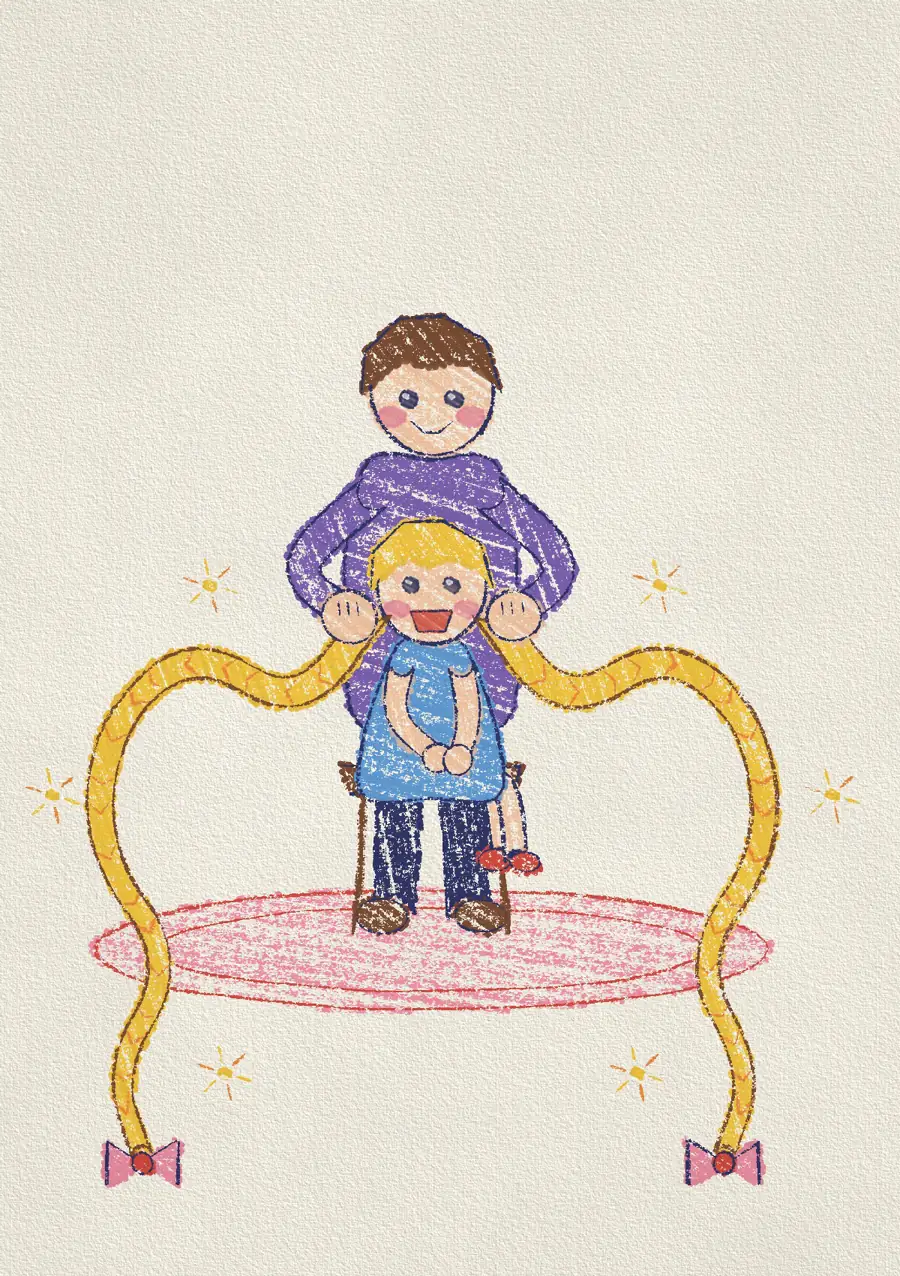
Picture a child's drawing of a girl with braids. Her dress might be a fill. Her braids, long and narrow, might be satin, which gives them a lovely shine. Her eyebrows and the strands at the end of each braid might be running stitches. Our film Hands Like Gold is about exactly such a drawing: a dad's hands holding his daughter's braids.
Stitch direction: the secret ingredient
The angle of stitches matters almost as much as the type. Because thread is shiny, its angle changes how it catches light. Two neighboring areas stitched in the same color but different directions will look like two shades.
Embroiderers use this to separate shapes, suggest movement (like hair or water) and give a flat design a sense of dimension.
How children's coloring translates into stitches
Children color in their own ways. A three-year-old scrubs back and forth, going well past the lines. A seven-year-old might color in careful stripes, or leave half a shape empty.
Good embroidery can honor that. Scrubbed toddler coloring can be suggested with fill stitches running in the same energetic direction. Our film Six Arms features a toddler drawing like that, with scribbled color going past every edge. Outlines that a child drew heavily can become bold satin borders, while lighter ones become running stitches.
At ANORA, we keep the drawing's character first. We don't color inside lines your child didn't color inside.
What this means for your design
- Bold shapes and clear outlines embroider beautifully
- Long, narrow shapes (arms, braids, rays of the sun) suit satin and look especially good
- Very fine pencil lines become running stitches and may be slightly thickened
- Large solid areas become fill, with a soft woven texture
Our film The Star on Top features a big, bold Christmas star: the kind of shape that stitches with a lovely shine.
You can upload a drawing here and see a preview on a hoodie or a T-shirt before you order.
Frequently asked questions
What is the difference between satin stitch and fill stitch?
Satin stitches are long, parallel and glossy, used for narrow shapes and borders. Fill stitches are shorter, arranged in offset rows, and used to cover larger areas with a flatter, textured finish.
What is a running stitch in machine embroidery?
A simple line of stitches, used for fine details, thin outlines, underlay and moving between areas. Repeated passes make the line bolder.
Why can't satin stitch be used for large areas?
Very long satin stitches become loose floats that can snag or sag. Wide areas are usually filled with fill stitches instead.
What is tatami stitch?
Tatami is another name for fill stitch: rows of short stitches with offset positions, creating a subtle woven texture over large areas.