Embroidery guide
Where Should Embroidery Go? A Placement and Size Guide for Shirts and Hoodies
Left chest, center chest, sleeve or back? Common embroidery placements and sizes for T-shirts and hoodies, and how to choose the right one for your design.
The same design can feel completely different depending on where it sits. A small emblem on the left chest says "polished and subtle." A larger piece in the center says "look at this." On a sleeve, it's a little secret.
Here's a guide to the most common embroidery placements on T-shirts and hoodies, typical sizes, and how to choose.
Why embroidery is usually smaller than prints
Printed designs can cover a whole shirt front. Embroidery is usually more compact, for practical reasons:
- Weight and stiffness. Thousands of stitches add weight. A very large, dense design can make a soft T-shirt stiff and heavy.
- Drape. A big stitched panel doesn't move with the fabric the same way.
- Detail. Thread has thickness, so a design needs a certain size to keep its details, but beyond a point, extra size doesn't add much.
That's why embroidery is usually more compact than a full-front print, with the size depending on placement.
Common placements
Left chest
The classic spot for logos on polos, work shirts and jackets. It sits over the heart, roughly where a shirt pocket would be.
Typical size: often around 3 to 4 inches wide. Best for: small logos, monograms, initials, simple icons. Feel: understated, professional.
Center chest
Centered on the front, a few inches below the collar.
Typical size: larger than left chest, often several inches wide, depending on the garment and design. Best for: designs meant to be seen and talked about: graphics, illustrations, children's drawings. Feel: confident, a statement piece.
On hoodies, center-chest designs sit above the front pocket, which limits how far down they can go.
Sleeve
On the upper arm or near the cuff.
Typical size: small, a couple of inches. Best for: small accents, dates, initials, a second little element. Feel: subtle, a detail people discover.
Back
Across the upper back, below the collar, or as a larger centered design.
Best for: names, team designs, bigger statements. Note: large back embroidery adds noticeable weight, so it suits hoodies and jackets better than light T-shirts.
Hood
Some hoodies have embroidery on the side of the hood. It's eye-catching but technically trickier, since hoods are curved and layered.
How to choose placement
Think about the design
- Simple and small (a monogram, a tiny heart): left chest or sleeve
- Detailed or meaningful (a drawing, an illustration): center chest gives it room to be seen
- Wide designs (a family lined up in a row): center chest or back
Think about the person
Someone who prefers understated clothing may love a small left-chest piece. Someone who wants to show off their grandkid's drawing to everyone at the grocery store will want it front and center.
Think about the garment
T-shirts are lighter, so a moderate design keeps them comfortable. Hoodies are heavier and handle bolder embroidery well, but the front pocket limits how low a design can sit.
Size and detail: the balance
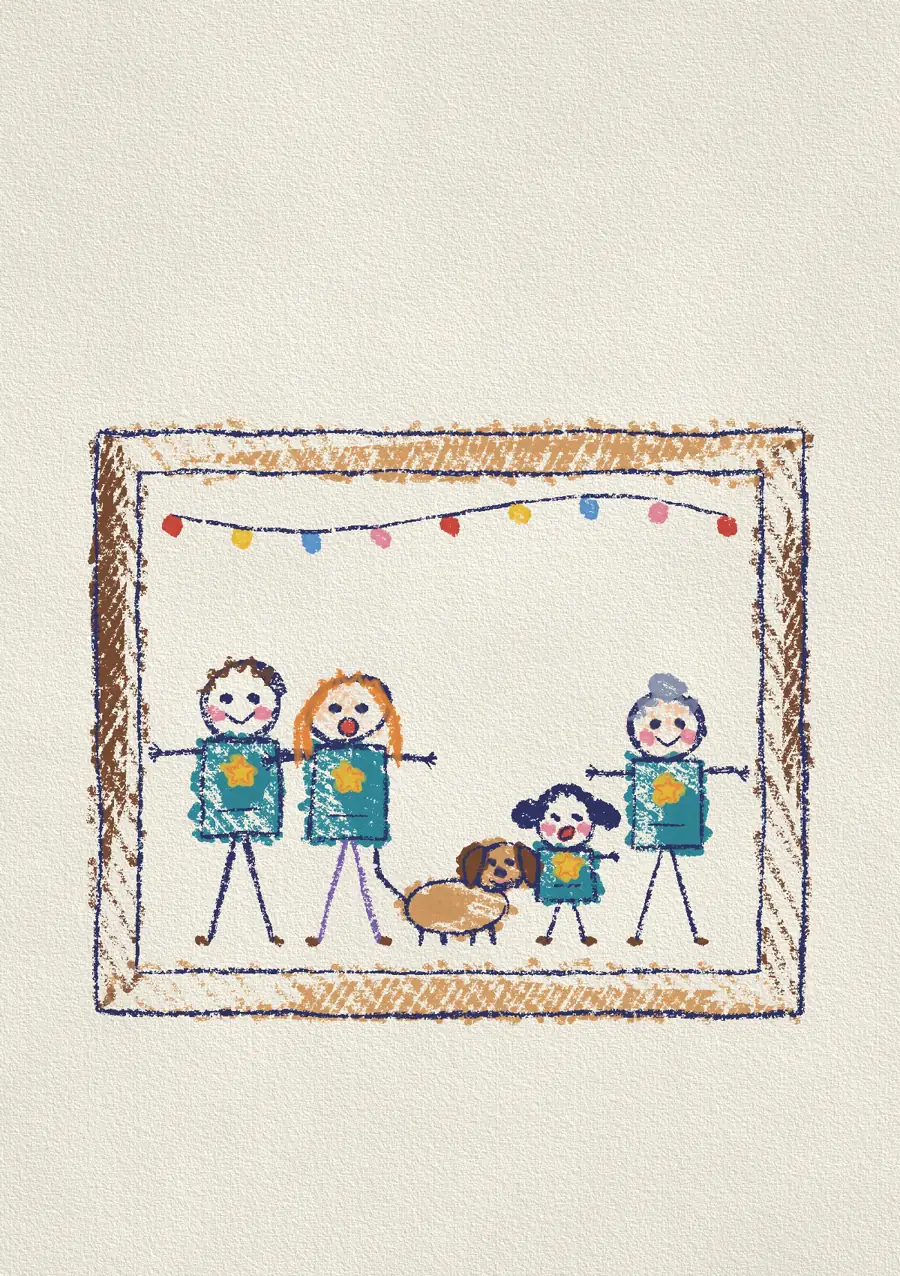
The smaller the embroidery, the more a design has to be simplified. A child's drawing of a whole family with names, a dog and a house needs enough size to keep each face readable. A single bold sun works at almost any size.
As a rule of thumb, the more there is in the drawing, the more room it needs.
Think about how it will be seen
A design on the chest is the first thing people notice in conversation and in photos. A sleeve design shows mostly from the side. A back design is seen as someone walks away, or across a room. For a gift meant to start conversations, like a grandchild's drawing, the front is usually the right answer.
Matching sets and placement
For matching family outfits made from one drawing, using the same placement on every garment creates a strong, coordinated look, especially in group photos. Our film The Christmas Photo is about a six-year-old who designed the family's matching Christmas outfits. In One Mitten Each, two cousins wear the same drawing. And in The Little Shadow, two brothers do.
How placement works at ANORA
On our hoodies and T-shirts, a child's drawing goes on the chest, where it can be seen and recognized. The placement shown in your product preview is the placement used for your order, so what you see before checkout is what you get. You'll also see your chosen garment color: Ivory, Sand, Clay, Sage or Black.
You can upload a drawing here and check the preview. During our grand opening, code BESTGIFT takes 15% off.
Frequently asked questions
What is the standard size for left chest embroidery?
Left-chest designs are commonly around 3 to 4 inches wide, though it varies by garment and design.
Where should embroidery go on a hoodie?
Center chest, above the front pocket, is the most popular spot for a statement design. Left chest suits small logos. Sleeves and the back are options for accents and larger designs.
How big can embroidery be on a T-shirt?
It depends on the design's density and the fabric. Very large, dense embroidery can make a T-shirt stiff and heavy, so moderate sizes are usually more comfortable.
Is center chest or left chest better?
Neither is better; they say different things. Left chest is subtle and classic. Center chest gives a design, like a child's drawing, room to be the star.