Embroidery guide
Embroidery Thread: Types, Colors and Why Your Design Uses a Palette
Polyester, rayon, cotton and metallic embroidery thread compared, why thread never quite matches crayon or a screen, and how many colors a design can use.
Most people never think about embroidery thread until they see a finished piece and notice how it shines, or wonder why the purple on their shirt isn't quite the purple on the screen. Thread is the paint of embroidery, and like paint, it comes in different materials with different strengths.
Here's a practical guide to the main thread types and to the color question that comes up most often: why can't embroidery match every color exactly?
The main types of embroidery thread
Polyester
Polyester is the workhorse of modern machine embroidery. It's strong, colorfast and resistant to bleach and repeated washing, which makes it a popular choice for clothing that will be worn and washed often: uniforms, sportswear, kids' clothes, hoodies.
It has a bright sheen, comes in a huge range of colors, and holds up well to the high speeds of commercial machines.
Rayon
Rayon has a beautiful, silky luster and was long the traditional choice for decorative machine embroidery. It's soft and drapes nicely, but it's generally less durable than polyester and can be more sensitive to harsh washing and bleach.
Cotton
Cotton thread has a soft, matte finish and a natural, handmade look. It's popular in hand embroidery and for vintage or heirloom styles. It doesn't shine like synthetic threads and can be less colorfast over many washes.
Metallic and specialty threads
Metallic threads add sparkle, and there are also glow-in-the-dark, variegated and other novelty threads. They can be trickier to stitch and are often used sparingly for accents.
Thread weight
Thread thickness is described by "weight": the higher the number, the finer the thread. A 40-weight thread is a very common standard in machine embroidery. Finer threads allow smaller detail; heavier threads give bolder coverage.
Why thread colors never exactly match the original
This is the question we hear most. The short answer: crayons, screens and thread are three completely different ways of making color.
Thread comes in set colors
Unlike ink, thread can't be mixed on the spot. Each spool is one fixed color, chosen from the manufacturer's range. The embroiderer picks the closest available thread for each area of the design.
Screens glow; thread reflects
A screen shows color with light shining at you. Thread shows color by reflecting light, and because it's shiny, the same thread looks lighter or darker depending on the angle and the lighting. Even the direction of the stitches changes how a color reads.
Crayon and marker are textured
A crayon on paper leaves a patchy layer with paper showing through. Thread covers solidly. So a crayon "yellow" often looks paler on paper than a solid block of yellow thread.
The garment color matters
The same thread looks different on ivory cotton and on black fabric. Darker garments make colors pop; lighter ones keep them softer.
How many colors can an embroidery design have?
Technically, a lot. But practically, each color means a thread change, more stitching time and more complexity, and very subtle color variations become hard to tell apart in thread anyway.
That's why most embroidered designs use a practical palette: enough colors to keep the design's character, not so many that it becomes muddy. Embroidery is at its best with clear, distinct colors.
Gradients and shading
Smooth gradients, like a sunset fading from orange to pink, can't be reproduced the way a printer would. Embroiderers simplify them into a few solid bands of color, or blend two threads at the edges. The result has its own charm, but it's a different look from print.
Why children's drawings and thread get along
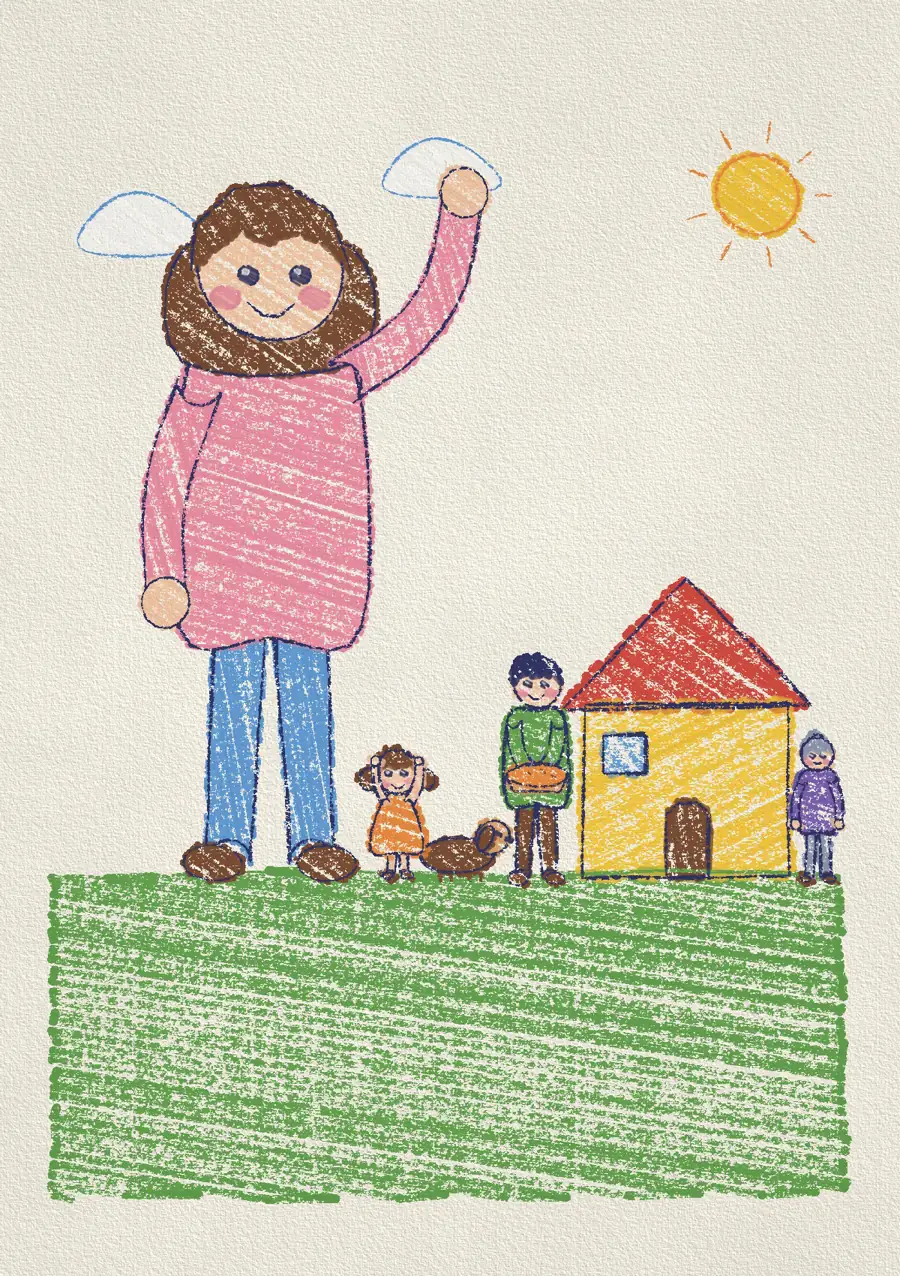
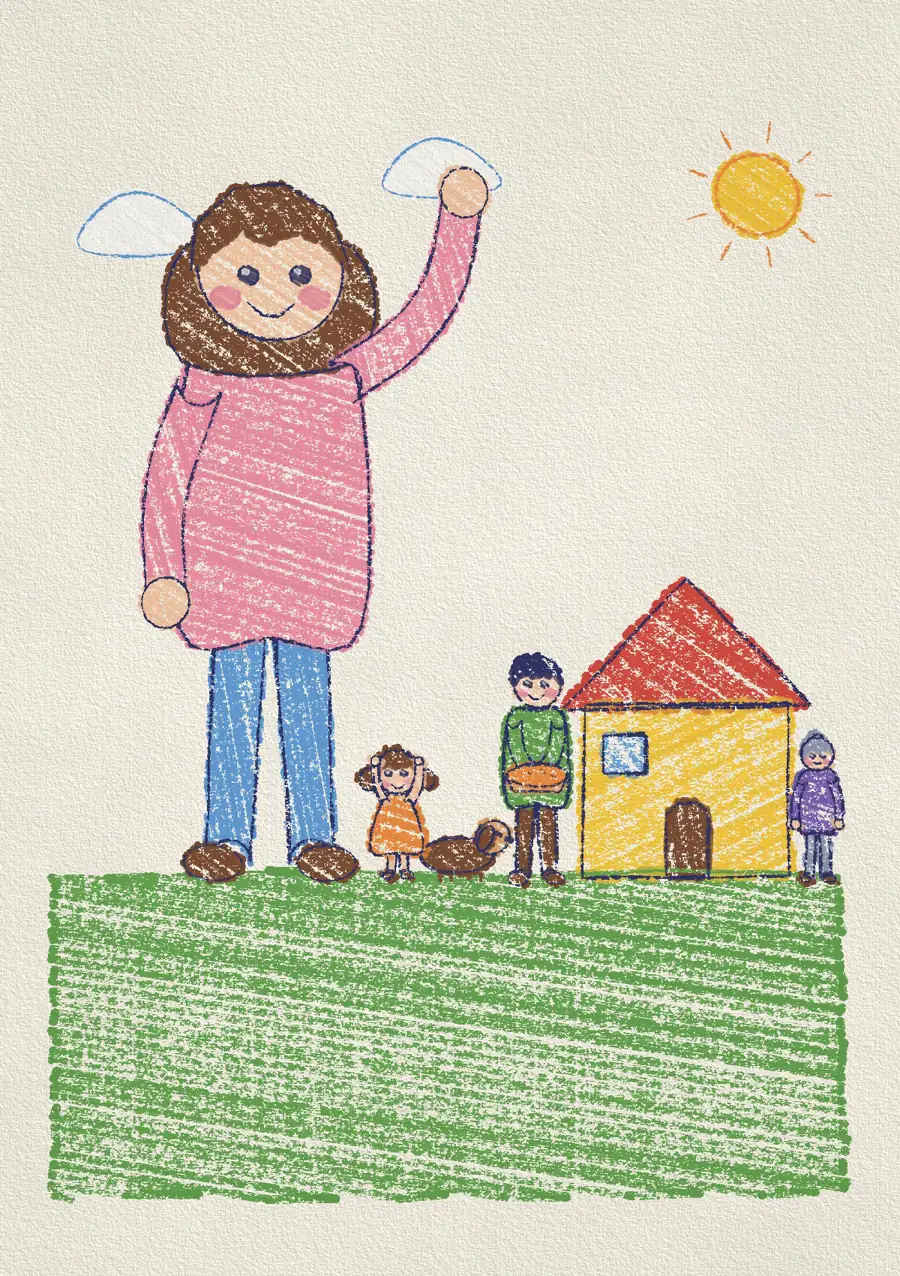
Children's drawings are naturally well suited to a thread palette. Kids tend to use a few bold, distinct colors, the ones in their crayon box, and they don't usually rely on subtle shading. A red roof, a yellow sun, a purple mom: each maps cleanly to a thread.
At ANORA, we map each drawing to supported production thread colors, trying to keep the original color relationships. If your child drew a blue sun next to a green cat, you'll get a blue sun next to a green cat. Our film No Wrong Colors is about an art teacher who said yes to the blue sun, and we'd say yes too.
We also keep the relative sizes your child chose, however "wrong." Our film Bigger Than the House explains why a mom taller than the roof makes perfect sense to a child. And One Cookie Each shows how a few warm, simple colors can hold a whole family Christmas tradition.
What to expect when you order
- Colors will be close, not identical. Thread and paper are different materials.
- Very subtle differences between two similar shades may be merged into one thread.
- Bold, clear colors come through beautifully.
- You'll see a preview before you order, showing the drawing on your chosen hoodie or T-shirt color.
You can upload a drawing here to see how it looks in thread. During our grand opening, code BESTGIFT takes 15% off.
Frequently asked questions
What is the best thread for machine embroidery on clothing?
Polyester is a popular choice for clothing that's washed often, because it's strong and colorfast. Rayon offers a silkier sheen but is generally more delicate.
Why does my embroidery color look different from my design?
Thread comes in fixed colors and reflects light differently from a screen or paper. Stitch direction, lighting and garment color also affect how a color looks.
Can embroidery do gradients?
Not the way printing does. Gradients are usually simplified into a few bands of solid color or blended at the edges.
What does 40-weight thread mean?
It describes thread thickness: higher numbers are finer. 40-weight is a common standard for machine embroidery.