Embroidery guide
Hand vs. Machine Embroidery: What's the Difference, and Which Should You Choose?
How hand and machine embroidery differ in look, feel, durability, cost and time, how to tell them apart, and which suits a keepsake you'll wear every day.
There's something romantic about hand embroidery: hours of patient work, a needle, a hoop on someone's lap. Machine embroidery sounds less poetic. But for a lot of purposes, especially clothing that gets worn and washed every week, machines have real advantages.
Neither is "better." They're different tools, with different strengths. Here's how they compare, and how to choose.
How hand embroidery works
A person stitches the design by hand, using a needle and thread (often stranded cotton floss), usually with the fabric stretched in a hoop. There's a huge vocabulary of hand stitches: backstitch, stem stitch, French knots, chain stitch, satin stitch and many more.
Each piece is unique. Even the same embroiderer stitching the same design twice will produce slightly different results.
How machine embroidery works
A design is first digitized into a stitch file. The fabric is stabilized and clamped in a hoop, and a computer-controlled machine stitches the design, moving the hoop under the needle and changing thread colors automatically. Commercial machines are fast and precise, and can reproduce a design consistently.
For more detail, see our guide to how machine embroidery works.
Side-by-side comparison
| Hand embroidery | Machine embroidery | |
|---|---|---|
| Time | Hours to weeks per piece | Minutes to an hour or so per piece, plus preparation |
| Look | Organic, slightly irregular, varied stitches | Even, precise, consistent |
| Texture | Often softer, with a wide variety of stitch effects | Dense, smooth, with a slight sheen (with polyester thread) |
| Durability | Varies; depends on stitches and thread | Very durable, designed for washing |
| Cost | Higher, because of the labor | More affordable, especially for single designs on clothing |
| Best for | Art pieces, heirlooms, decorative textiles | Clothing, logos, everyday wear |
How to tell them apart
Look at the back. Hand embroidery usually has visible knots, thread tails and travel stitches that vary. Machine embroidery typically has a stabilizer backing and a regular pattern of bobbin thread.
Look at the front. Hand stitches often vary slightly in length and spacing. Machine stitches are very regular, especially in fill and satin areas.
Look at the threads. Hand embroidery often uses matte cotton floss, sometimes with several strands. Machine embroidery often uses a single, smooth, slightly shiny thread.
When hand embroidery is the right choice
- Art pieces and wall hangings, where the stitching itself is the point
- Heirloom textiles: christening gowns, quilts, samplers
- When the making is the gift: a parent embroidering a child's drawing by hand over several evenings
- Delicate fabrics that wouldn't survive a machine hoop
If you embroider, stitching a child's drawing by hand can be a beautiful project. Simple stitches like backstitch for outlines and satin stitch for small shapes go a long way.
When machine embroidery is the right choice
- Clothing that gets washed often: hoodies, T-shirts, uniforms
- Durability and consistency, so the design looks the same after many washes
- Matching sets, like the same drawing on several family members' hoodies
- Time and budget, when hours of hand stitching aren't realistic
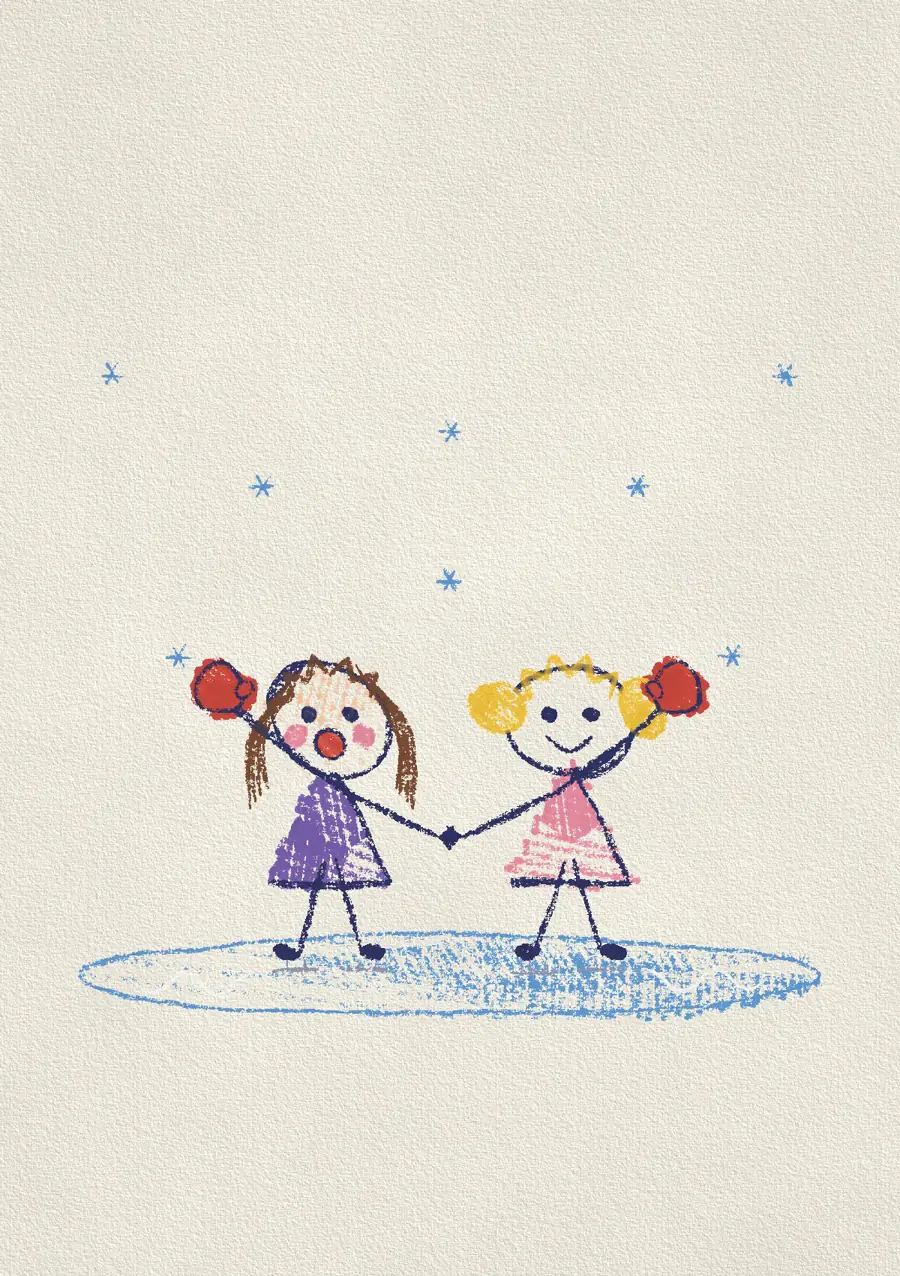
Our film One Mitten Each is about two cousins who wear the same drawing, the kind of matching pair machine embroidery makes possible.
Is machine embroidery "less personal"?
It's a fair question. A machine does the stitching, but the personal part isn't the needle. It's the design, the decisions, and what the piece means.
With a child's drawing, the personal part is already there: the child's hand made every line. Machine embroidery's job is to translate those lines faithfully into thread. At ANORA, we prepare each drawing to keep its character: the wobble, the proportions, the colors. We don't redraw or "improve" it. Our film Why We Never Fix a Child's Drawing explains why.
And knitting, embroidery's cousin, shows how meaning lives in what's made for someone. Our film One Scarf for Everyone is about a great-grandma who knitted for the whole family.
A middle path
Some people love both: a machine-embroidered piece for everyday wear, and a hand-embroidered version of the same drawing framed on the wall. Or a machine-embroidered hoodie with a few hand-stitched initials added later.
Choosing for a gift
Ask yourself how the gift will be used:
- Displayed and admired? Hand embroidery is lovely.
- Worn, washed and lived in? Machine embroidery is built for it.
If you'd like a child's drawing embroidered on a hoodie or a T-shirt, you can upload it here and see a preview before ordering.
Frequently asked questions
Is hand embroidery better than machine embroidery?
Not inherently. Hand embroidery offers unique, organic artistry; machine embroidery offers durability, precision and consistency for clothing.
How can you tell if something is hand embroidered?
Check the back for knots and irregular travel stitches, and look for slight variations in stitch length on the front. Machine embroidery usually has a regular pattern and a stabilizer backing.
Is machine embroidery durable?
Yes. It's designed for clothing that's worn and washed, and with reasonable care it holds up very well.
Why is hand embroidery so expensive?
Because it takes many hours of skilled labor. A design that a machine stitches in minutes can take a person days.