Kids' art
The Stages of Children's Drawing: From First Scribbles to "Real" People
How children's drawing develops: scribbling, tadpole people, baselines and skylines, then realism. What's typical at each age and what it tells you.
Somewhere between a toddler's first crayon mark and a ten-year-old's careful cartoon, something remarkable happens. Random lines become circles, circles become faces, faces sprout arms straight from the head, and one day you realize your child has drawn the whole family standing on a line of grass under a strip of blue sky.
Children's drawing develops in fairly predictable stages. Knowing them helps you enjoy each one, and know which drawings capture a moment you'll never see again.
A note on ages
The stages below are widely described in child development and art education, most famously by the art educator Viktor Lowenfeld in his 1947 book Creative and Mental Growth. The ages are approximate. Children move through the stages at their own pace, may overlap stages, and may jump back and forth. A child who seems "behind" or "ahead" is usually just being themselves.
Stage 1: Scribbling (roughly ages 1½ to 4)
Random scribbles
The first marks are mostly about movement: the joy of moving an arm and seeing a line appear. Lines go everywhere, often off the page. Toddlers may not look at the paper much.
Controlled scribbles
Gradually, children gain more control. Lines repeat, loops appear, and they start to keep the marks on the paper. They watch what they're doing.
Naming the scribble
A big moment: the child starts naming their scribbles. "That's Daddy." "That's a dog running." The drawing doesn't look like the thing yet, but the idea that marks can represent something has arrived.
What to keep: an early scribble, and especially one your child named. Write down what they said.
Stage 2: Early representation (roughly ages 3 to 7)
This stage is sometimes called the preschematic stage.
Circles and the first people
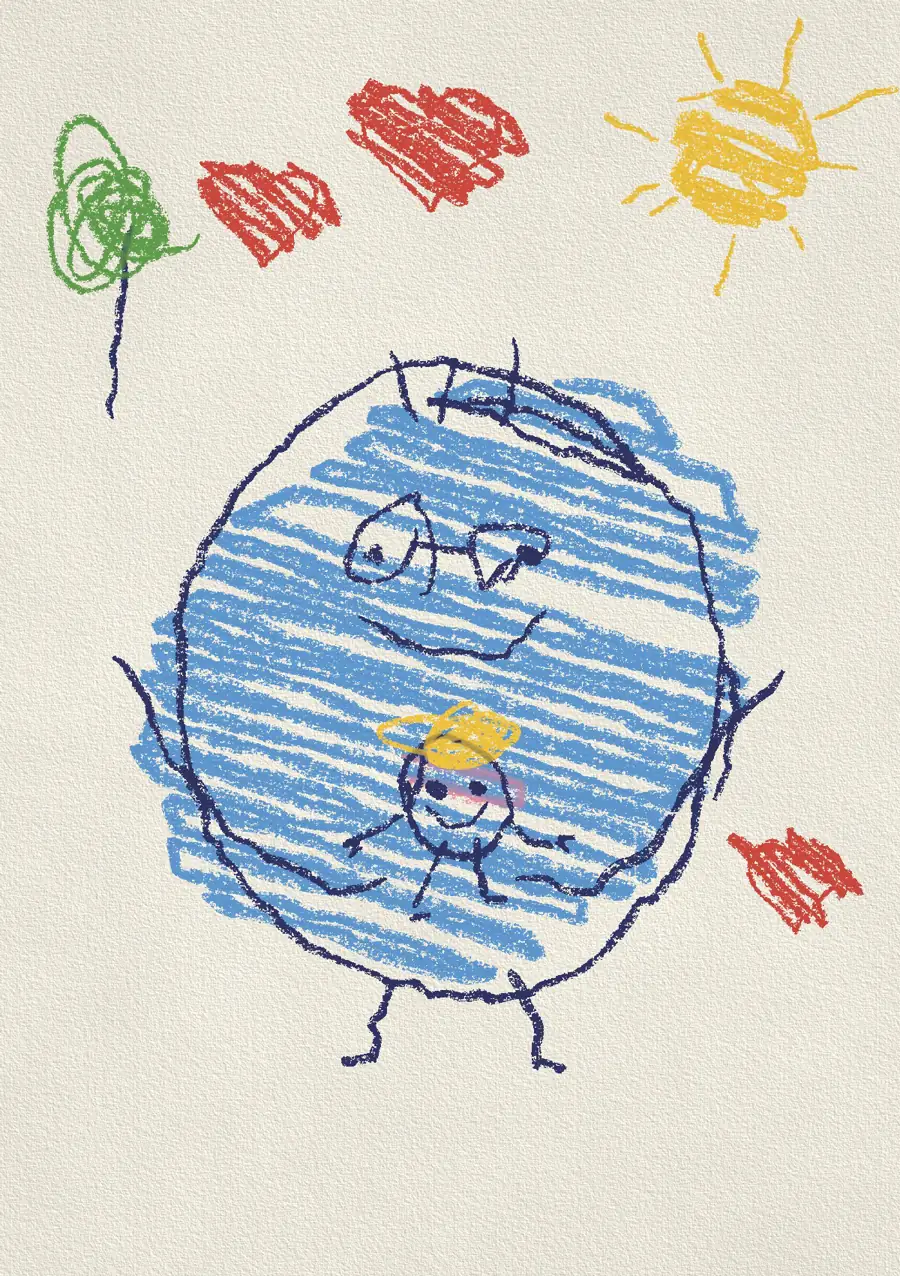
Children discover the circle, and soon after, the first person. Often it's a "tadpole" figure: a big circle for the head (and body), with arms and legs sticking straight out of it. Sometimes there's a face; sometimes just eyes.
Tadpole people are one of the most charming and short-lived stages. Our film The Biggest Hug is about a three-year-old who drew grandpa as one big blue circle, his arms wrapped around a tiny pink dot: her. In Six Arms, a three-year-old drew his mom with six arms coming out of her head.
Floating objects
Things float in space: a house, a sun, a person, a cat, arranged anywhere on the page, often at different sizes. There's no ground yet.
Size means importance
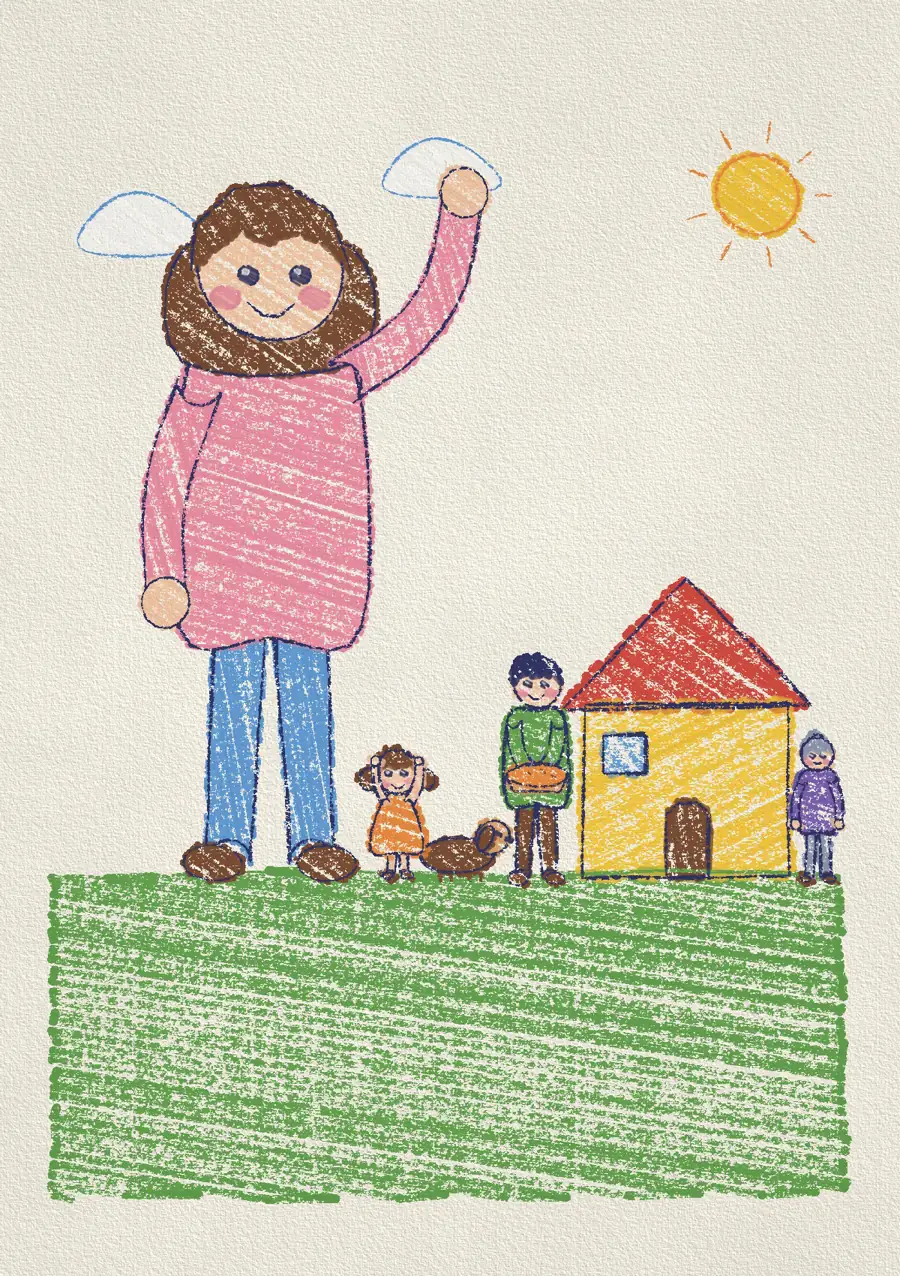
Children often draw what matters most as biggest. Mom may be taller than the house; a favorite toy may be bigger than a sibling. It's not an error. It's emotional accuracy. Our film Bigger Than the House explores exactly this.
Color by feeling
Colors are chosen because the child likes them, not because they match reality. A purple dog is perfectly reasonable.
What to keep: the first tadpole person, the first family portrait, any drawing where size tells you who matters.
Stage 3: The schema (roughly ages 7 to 9)
In this stage, often called the schematic stage, children develop a personal "formula" (a schema) for drawing things: their house, their tree, their person. They repeat it, with variations.
The baseline and the skyline
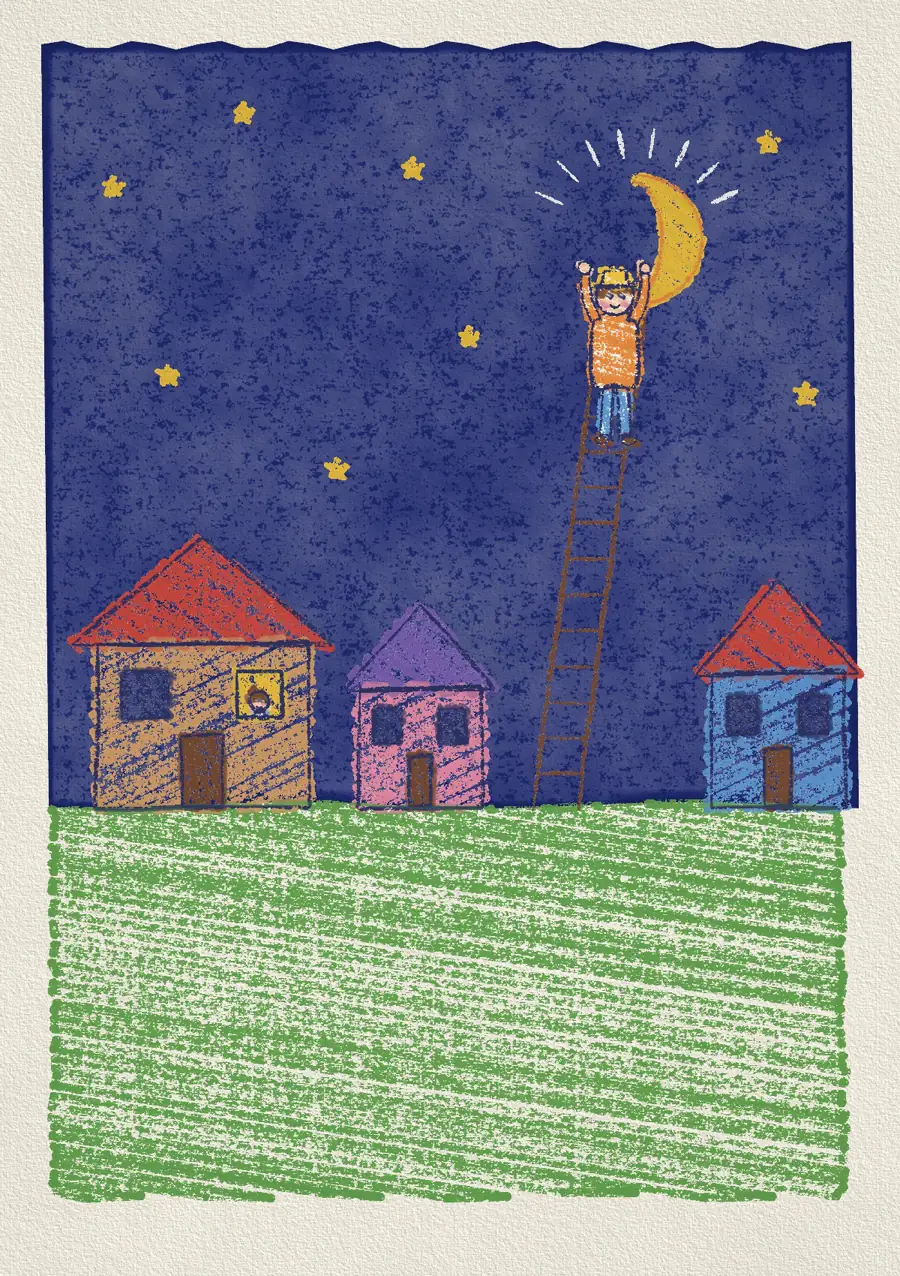
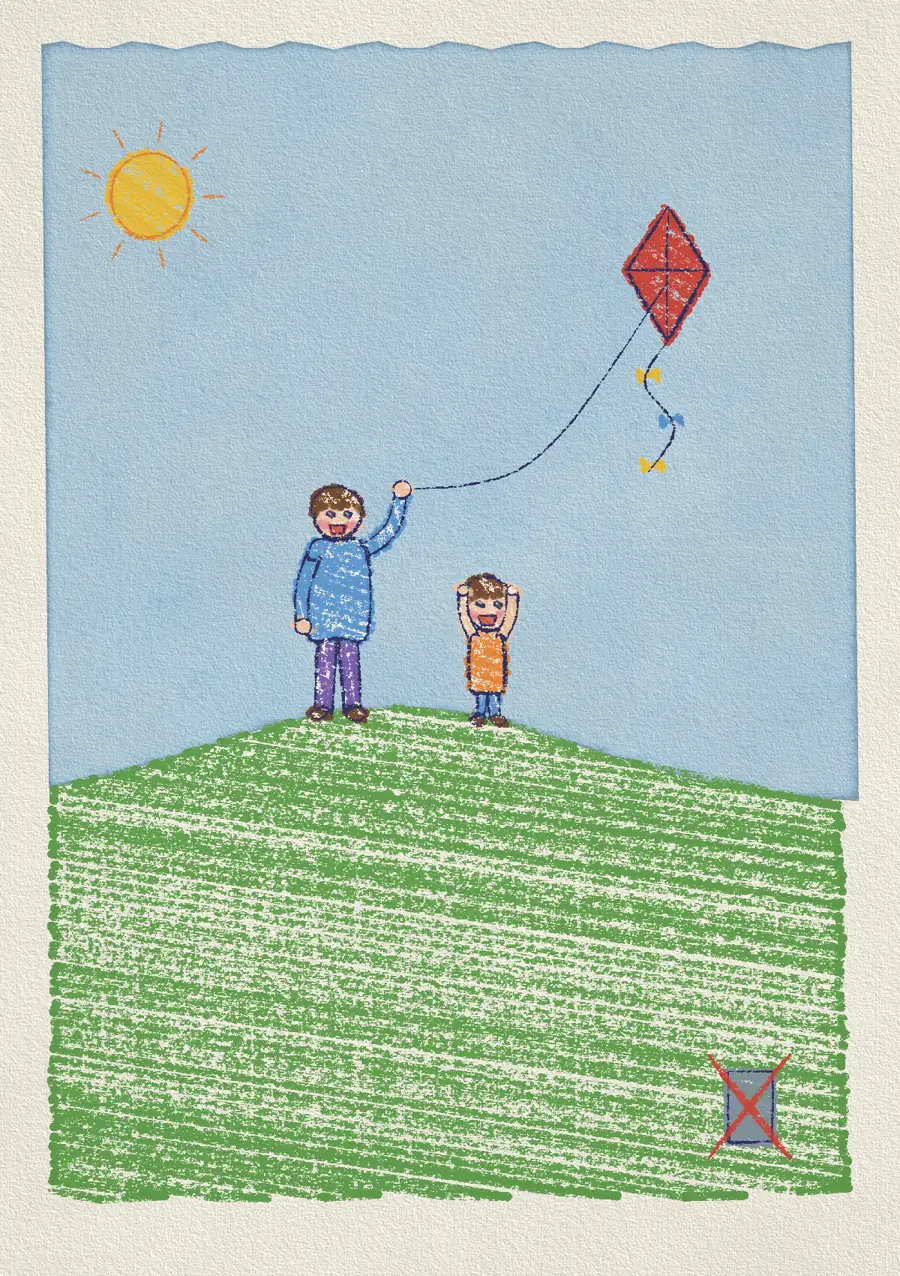
A big change: a line across the bottom of the page appears, and everything stands on it. Often there's also a strip of blue at the top: the sky. Between them is air.
X-ray drawings
Children may show the inside and outside of something at once: people visible inside a house, food inside a stomach, a baby inside mom. They draw what they know is there, not just what they see.
Folding over
Sometimes things are drawn from several viewpoints at once: a table with all four legs sticking out, a street with houses on both sides drawn upside down.
Exaggeration still matters
Important parts are still enlarged: a giant hand that waves, a huge ear that listens.
What to keep: a typical schema drawing (their standard house and family), and anything with x-ray or folded views. These disappear as realism arrives.
Stage 4: Toward realism (roughly ages 9 to 12)
Children become more interested in drawing things "correctly." They notice details, overlap objects, and try perspective. Many become self-critical: "It doesn't look right." Some draw less; others get deeply into it, often favoring cartoons, comics, or a favorite subject like animals or vehicles.
What to keep: drawings they're proud of, and the subjects they loved at that age.
Stage 5: Adolescence (roughly 12 and up)
Teens who keep drawing may develop real skill and style. Many stop drawing entirely, which makes the earlier drawings even more precious.
What these stages tell parents
- "Wrong" is right. Big heads, floating houses, purple suns are how children's thinking looks on paper. Don't correct them.
- Each stage is short. The tadpole stage may last only a year or so. Keep a few examples.
- Ask, don't guess. "Tell me about your drawing" gets you the story behind it.
- Labeled drawings become a record. Name, age, date and what the child said.
For tips on keeping drawings from each stage, see our guide to organizing kids' artwork.
Keeping a stage you'll miss
Each stage is a snapshot of how your child understands the world at that moment. A tadpole portrait of grandpa or a schema drawing of the family house won't be repeated once the child moves on.
If one of those drawings becomes a family favorite, it can be kept in a way that lasts. At ANORA, we embroider children's drawings on hoodies and T-shirts, preserving the proportions and lines of whatever stage they're from. You can upload a drawing here and preview it first.
Frequently asked questions
At what age do children start drawing people?
Many children draw their first recognizable person, often a tadpole figure, somewhere around ages 3 to 4. The timing varies widely.
What is the tadpole stage in children's drawing?
It's an early stage when children draw people as a large circle with arms and legs attached directly to it, with no separate body. It's normal and usually passes within a year or two.
Why do kids draw people bigger than houses?
Young children often draw important things larger. Size reflects emotional importance rather than physical reality.
What are Lowenfeld's stages of artistic development?
Viktor Lowenfeld described stages including scribbling, preschematic, schematic, the gang age or dawning realism, and the pseudo-naturalistic stage of early adolescence. They're a widely used general framework, with approximate ages.